Ekvtime Takaishvili examines the treasures he brought back to Georgia from France in 1945, accompanied by staff members of the Georgian Museum of Fine Arts. The collection includes the Tsereteli manuscript of The Knight in the Panther’s Skin, the Gelati and Tskarostavi Gospels, Tamar’s Cross, and various processional crosses.
Silent footage.
1947. Director and Cinematographer: Alexander Semionov.
Ekvtime Takaishvili - Historian, Archaeologist, Pedagogue and Public Figure
Ekvtime Takaishvili was born on 5 January 1862 in the village of Likhauri, in the Ozurgeti district of Georgia. His father, Simon Takaishvili, a member of the Georgian nobility, died shortly after his birth, while his mother, Nino, daughter of Prince Gituli Nakashidze, passed away when he was five years old. Following the loss of his parents, his relatives took responsibility for his upbringing.
At the age of seven, Takaishvili enrolled at the Ozurgeti District School, where he studied religious doctrine under Archpriest Simon, the brother of Bishop Gabriel Kikodze. After completing his studies in Ozurgeti, he spent a year in Poti before continuing his education in the second grade of the Kutaisi Progymnasium. In 1879, he transferred to the Kutaisi Classical Gymnasium, entering the fifth grade. Upon graduating in 1883, Ekvtime Takaishvili travelled to St. Petersburg, where he studied at the Faculty of History and Philology of the University, specialising in Greek and Latin languages (1883–1887).
Upon returning to Georgia, Takaishvili began his professional career as a teacher. He taught Greek and Latin, as well as history and geography.
Ekvtime Takaishvili during his studies at the Kutaisi Classical Gymnasium
Kutaisi, 1883
Ekvtime Takaishvili’s Academic Record
1882
“Promoted to the Eighth Grade”
Certificate confirming Ekvtime Takaishvili’s enrolment at the Kutaisi Progymnasium from 3 September 1876 to 5 June 1879
1879
Ekvtime Takaishvili’s Certificate of Maturity
Kutaisi, 4 June 1883
Ekvtime Takaishvili and Nino Poltoratskaya
With the support of Ilia Chavchavadze, Ekvtime Takaishvili married Nino, the daughter of Ivane Poltoratsky, on 5 July 1895. Of Polish descent, Ivane Poltoratsky was a well-known notary in Tbilisi. His relationship with Ilia Chavchavadze began when they were students at the Tbilisi Noblemen’s Gymnasium and continued throughout their lives. Ilia dedicated his poem "The Phantom" to Ivane Poltoratsky. The family of Poltoratsky’s wife, Nadezhda Gabashvili, owned extensive estates and two large houses in Tbilisi. The Poltoratsky children grew up in comfortable circumstances. Nino Poltoratskaya had a good command of Russian and French. She graduated from a conservatory in Paris and was an accomplished pianist.
Ekvtime and Nino were married at the Holy Trinity Church in Tbilisi. At the time, Ilia was in France and sent the newlyweds a valuable wedding gift from Paris. Nino carefully preserved the candles lit during their wedding ceremony throughout her life.
Ekvtime Takaishvili with his family members
After completing four years of study in St. Petersburg, the young Ekvtime Takaishvili returned to Georgia and began working as a Latin teacher at the Tbilisi Noblemen’s School. As he had not yet gained experience in teaching classical languages, he initially attended the lessons of distinguished classicists teaching at Tbilisi gymnasiums. He subsequently worked as a teacher of history and Latin at the Second Women’s Gymnasium and the Sixth Men’s Gymnasium in Tbilisi.
In 1894, Ekvtime Takaishvili was elected head of the Tbilisi Noblemen’s School. Under his leadership, the school attracted some of the finest teachers, the number of pupils increased considerably, and improvements in teaching raised the overall standard of students’ knowledge. Although the institution was officially designated as a noblemen’s school, thanks to the efforts of leaders such as Takaishvili, talented children from families belonging to the so-called lower social classes were also secretly admitted.
In addition to achieving academic success, the young people studying there developed a strong sense of patriotism. Despite persecution by officials of the Tsarist regime, they refused to submit, continued their education, and prepared themselves to serve their nation. Ekvtime Takaishvili was a strict yet deeply beloved mentor to these students, as well as a respected and highly esteemed leader of the teaching staff, a position he held for ten years.
In 1904, Takaishvili left the school. However, as he needed to provide for his newly established family, he continued working as a history and Latin teacher at various state gymnasiums in Tbilisi until the founding of the Georgian University.
Teachers of the Tbilisi Gymnasium, including Ekvtime Takaishvili
Ekvtime Takaishvili with the gymnasium students
Ekvtime Takaishvili made a significant contribution to the establishment of Tbilisi University. Together with Ivane Javakhishvili, he was elected to the commission of the “Society for the Georgian University” to draft the university’s statute and address other organisational matters.
On 12 May 1917, the first meeting of the founders of the University Society was held at the residence of Petre Melikishvili. The meeting, attended by 28 people, was chaired by Ekvtime Takaishvili. Early 1918 was designated as the tentative date for the university’s establishment. Ekvtime became a member of the commission responsible for organising academic matters.
Following the university’s opening, Ekvtime Takaishvili lectured in archaeology and served as Head of the Department of Archaeology. On 21 May 1918, the Council of Tbilisi University awarded him a doctoral degree. By 1920, Ekvtime Takaishvili was delivering three lectures per week: Introduction to the Antiquities of Georgia (Stone, Bronze and Iron Ages); General Survey of the Antiquities of Georgia’s Historical Period; Epigraphy and the History of Churches and Monasteries.
The Initiative to Establish the Central Archive
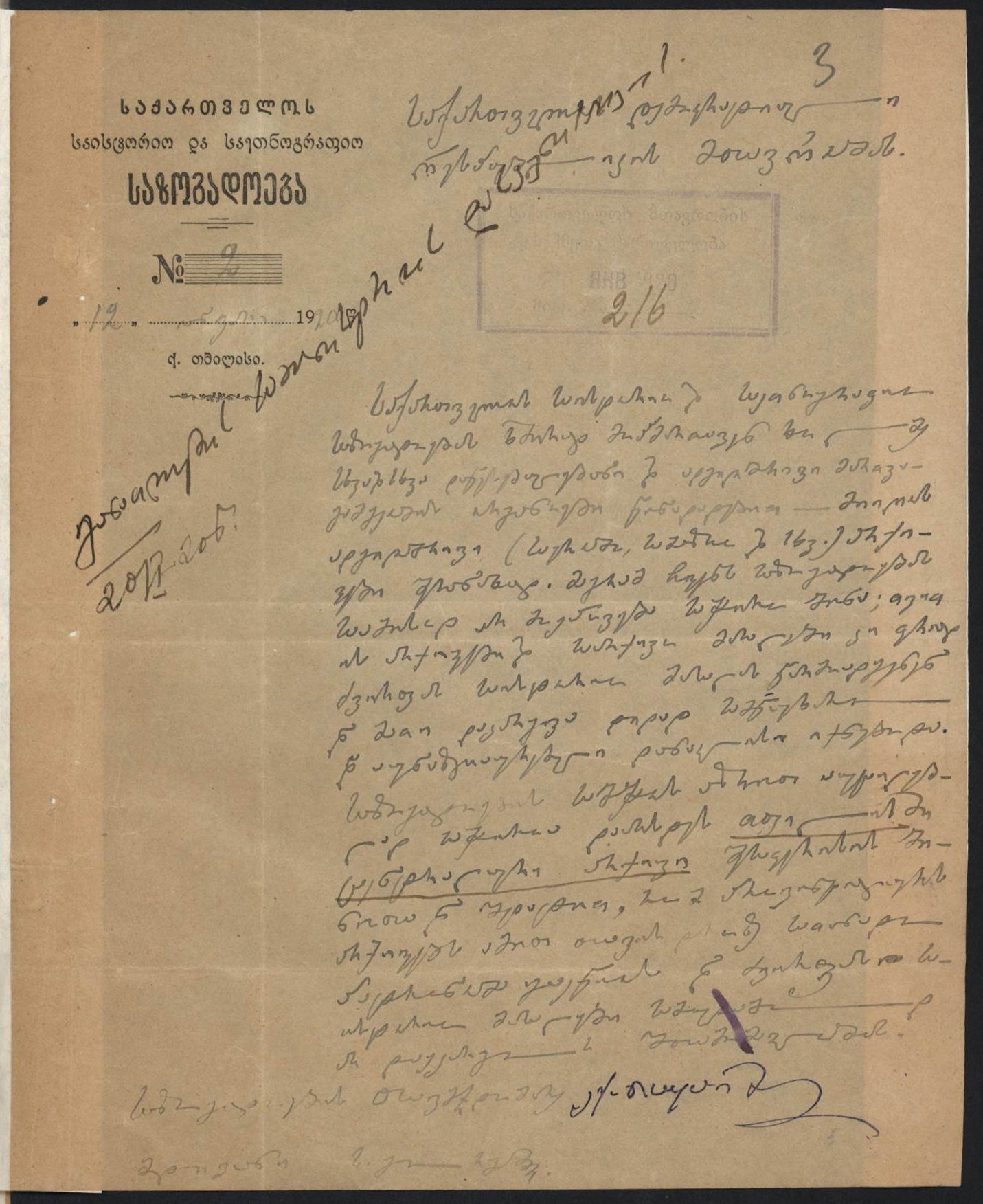
As the head of the Historical and Ethnographic Society, Ekvtime Takaishvili wrote to the government:
“The Georgian Historical and Ethnographic Society is frequently approached by various institutions and local self-government bodies with proposals to accept local, district, provincial and other archives for safekeeping. However, our Society does not have suitable premises for this purpose. These archives and archival materials are, in themselves, extremely valuable historical sources, and their loss would constitute a deeply regrettable and irreparable loss.
In the opinion of the Society’s Council, it is absolutely essential to establish a Central Archive in Tbilisi, with suitable premises and staff, so that provincial archives may receive proper care in due course and valuable historical materials may not be lost to future generations.
Chairman of the Society,
Ekvtime Takaishvili”
12 January 1920.
Archaeological expeditions were conducted in various regions of Georgia under the initiative of Ekvtime Takaishvili
The Gospel of Ancha (12th-13th centuries) and the Gospel of Kalmakhi Fortress (1534)
In 1895, Ekvtime Takaishvili travelled to Tsalka specifically to examine and document both Gospels. He also left behind invaluable records concerning these manuscripts, as by 1923, when the Gospels were deposited in the Archive for safekeeping, the manuscripts had already suffered significant losses, including the loss of their miniatures and colophon inscriptions.
In January 1888, Ekvtime Takaishvili became a member of the Board of the Society for the Spreading of Literacy among Georgians. His name is associated with the establishment of numerous schools, the publication of books, the enrichment of the Society’s library and museum, and the preservation of numerous Georgian manuscripts, historical documents and other antiquities.
In 1899, Ekvtime Takaishvili founded a highly significant scholarly series - "Georgian Antiquities", followed later by "Old Georgia". He personally edited the volumes of both series. These publications preserved invaluable information about Georgia’s antiquities, historical charters and deeds, as well as facts of historical significance.
In 1907, on the initiative of Ekvtime Takaishvili, the Georgian Historical and Ethnographic Society was founded. Beginning in 1908, the Society organised archaeological expeditions in Kartli. In 1910, similar expeditions were conducted in Lechkhumi and Svaneti, and in 1913, in Guria-Samegrelo and Imereti. Between 1902 and 1917, Ekvtime Takaishvili travelled to southern Georgia on three occasions, and in 1919-1920, he travelled to Racha. During these expeditions, important information about Georgia’s historical monuments was collected and subsequently published.
Ekvtime Takaishvili’s Expedition to Southern Georgia, 1902
Ekvtime Takaishvili beside a column of Oshki Cathedral.
Expedition in Southern Georgia.
1917
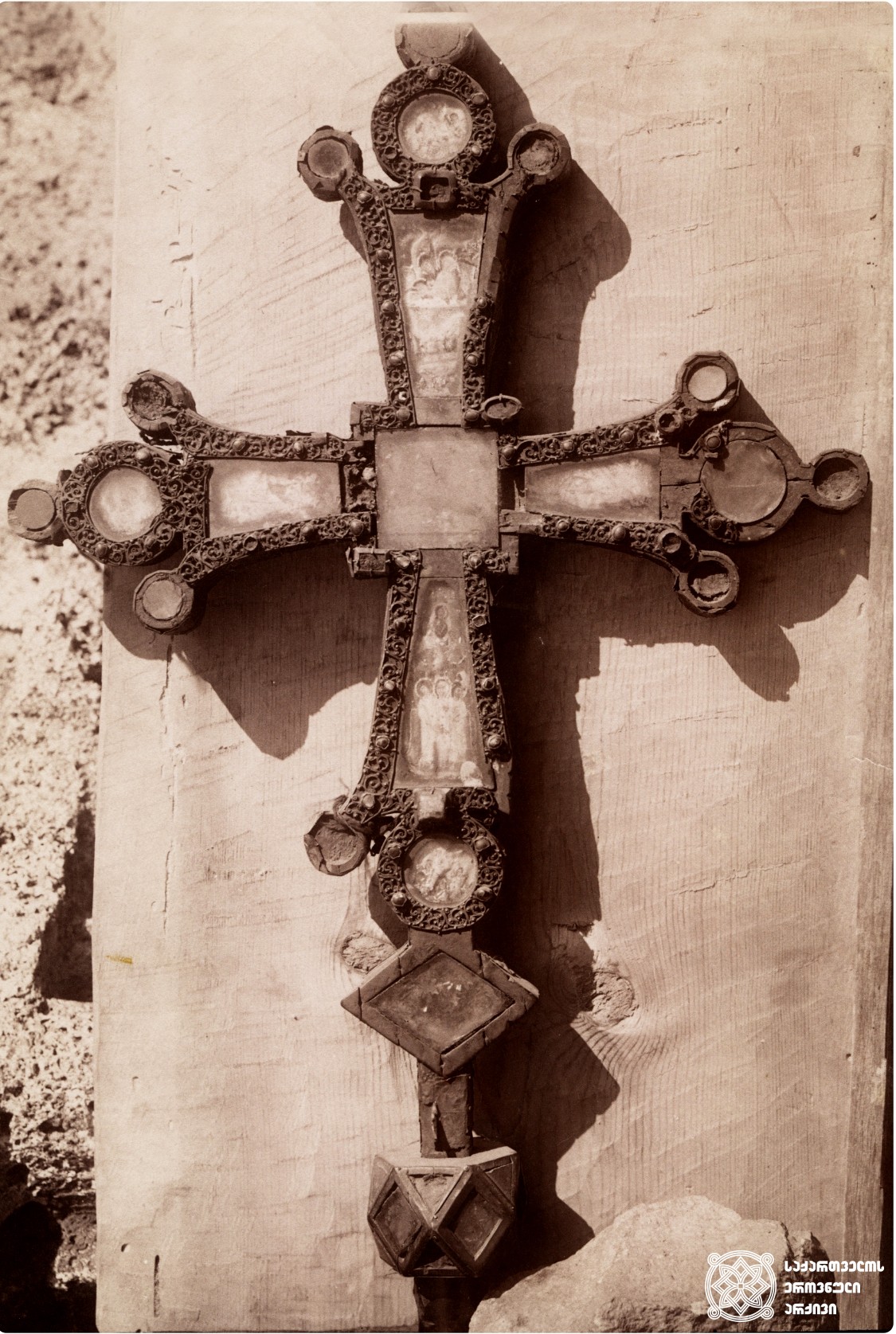
The Venetian Cross of the Sanctuary.
Latali community, village of Enashi, Ekvtime Takaishvili’s expedition in Svaneti.
1910
“It is found only in Svaneti and is still unknown in other parts of Georgia,” — Ekvtime Takaishvili on the Venetian Cross.
“Icon of the Archangel, painted with medicinal paint.”
Ipari Community, Village of Zegani, Ekvtime Takaishvili’s Expedition in Svaneti.
1910.
Upper: Iconostasis of Martvili Cathedral.
Lower: Ecclesiastical Treasures of Martvili Monastery.
Ekvtime Takaishvili’s Expedition in Guria-Samegrelo and Imereti.
1913.
Sakosi
Ekvtime Takaishvili’s Expedition in Guria-Samegrelo and Imereti.
1913
Ekvtime Takaishvili’s Expedition in Guria-Samegrelo and Imereti, 1913.
In 1917, under the leadership of Spiridon Kedia, the National Democratic Party was established. Niko Nikoladze served as the party’s honorary leader, while Ekvtime Takaishvili was among Spiridon Kedia’s closest associates.
In November 1917, Ekvtime Takaishvili participated in the work of the National Council of Georgia on behalf of this party. His signature appears on the Act of Independence of Georgia, which was adopted by the National Council at its very first session.
In 1919, Ekvtime Takaishvili was elected as a member of the Constituent Assembly on the National Democratic Party’s electoral list. From 1919 to 1921, he served as a member of the Presidium of Georgia’s legislative body and as Deputy Chairman. He was also a member of the Territorial Commission, which was tasked with examining the disputed territories between Armenia and Georgia. He was entrusted with documenting the condition of churches and monasteries and cataloguing their antiquities. Ekvtime Takaishvili continued his active political and cultural work while in exile.
Session of the Constituent Assembly of the Democratic Republic of Georgia, 1919.
Act of Independence of Georgia, adopted at the session of the National Council of Georgia on 26 May 1918 and ratified by the Constituent Assembly of Georgia on 12 March 1919.
Alongside other members of the Government of Georgia and the Constituent Assembly, Ekvtime Takaishvili signed the Act (the second signature in the second column from the left).
The document belongs to the Parliament of Georgia and is preserved in the National Archives of Georgia.
Presidium of the Constituent Assembly of the Democratic Republic of Georgia:
Balcony of the Government Palace (present-day National Youth Palace).
Tbilisi, 1919.
Autobiography, 1918:
“Ekvtime, son of Simon, Takaishvili
A National Democrat, was born in the village of Lekhouri, in the Ozurgeti District of Guria, on 5 January 1863*. After graduating from Kutaisi Gymnasium, he enrolled at the University of Petrograd, graduating from its Faculty of History and Philology in 1887. He initially worked as a teacher, then served as Head of the Tbilisi Noblemen’s School, and subsequently taught history and Latin at the Second Girls’ and Sixth Boys’ Gymnasiums in Tbilisi. He is currently Professor of Archaeology at Tbilisi State University and has been awarded the degree of Doctor honoris causa by the University Council. He participated in the activities of all Georgian cultural institutions. He is the founder of the Georgian Historical Ethnographical Society and has served as its Chairman since its establishment in 1907. He is a member of numerous scientific and charitable societies. He served as Secretary of the Caucasus Section of the Moscow Archaeological Society and is currently an honorary member of the same section. He is a full member of the Caucasus Institute of History and Archaeology. He has authored numerous scholarly works and publications in Georgian and Russian (listing them individually would require considerable space). Two of his works have been awarded gold medals: one by the Russian Academy of Sciences and the other by the Russian Archaeological Society.”
*According to the church register, Ekvtime was born on 5 January 1862; however, in his autobiography, he gives 1863 as his year of birth.
Celebration Marking the De Jure Recognition of the Independence of the Republic of Georgia
“When three republics were established in Transcaucasia, all three were recognised de facto, but Georgia alone succeeded in securing de jure recognition from the Entente. Neither of our neighbours was granted this distinction. Georgia’s sovereignty was recognised not only by the European states but also by Russia, which formally acknowledged its sovereignty within its existing borders through a special treaty,” wrote Ekvtime Takaishvili.
Ekvtime Takaishvili, Deputy Chairman of the Constituent Assembly, is standing first from the right on the podium.
Tbilisi, 6 February 1921
In 1921, following the occupation of the Democratic Republic of Georgia by Soviet Russia, Ekvtime Takaishvili was first entrusted with the evacuation of museum antiquities to Batumi and subsequently with the supervision and protection of the National Treasury. He was thus forced into exile. Together with his wife, Nina Poltoratskaya, he settled in Leuville, near Paris.
During his exile, he continued his scholarly activities. In 1922, he was elected a member of the Numismatic Society of Paris, and in 1925, a full member of the French Asiatic Society. Between 1937 and 1939, while in exile, Ekvtime headed the “Fund for the Publication of Georgian Cultural and Archaeological Materials”, which he had founded. He was also elected to the Academic Council of the London-based scholarly periodical "Georgika". Ekvtime actively contributed to Georgian periodicals, including the newspaper "Independent Georgia" and the journals "Samshoblo", "Kavkasioni", "Jvari Vazisa", "Kartlosi", and "Bedi Kartlisa". He also participated in the establishment of the Georgian Church of St. Nino in Paris and was elected a permanent member of its Board of Trustees.
Through his efforts, towards the end of the Second World War, an agreement was reached between the Government of the Democratic Republic of Georgia in exile and the State Museum of the Georgian SSR concerning the transfer to the museum of the National Treasury that had been taken out of Georgia. On 11 April 1945, Ekvtime Takaishvili brought Georgia’s National Treasury back to his homeland.
The Leuville Estate and Members of the Georgian Orthodox Parish in Paris
Ekvtime Takaishvili in the Garden of Leuville. 1940
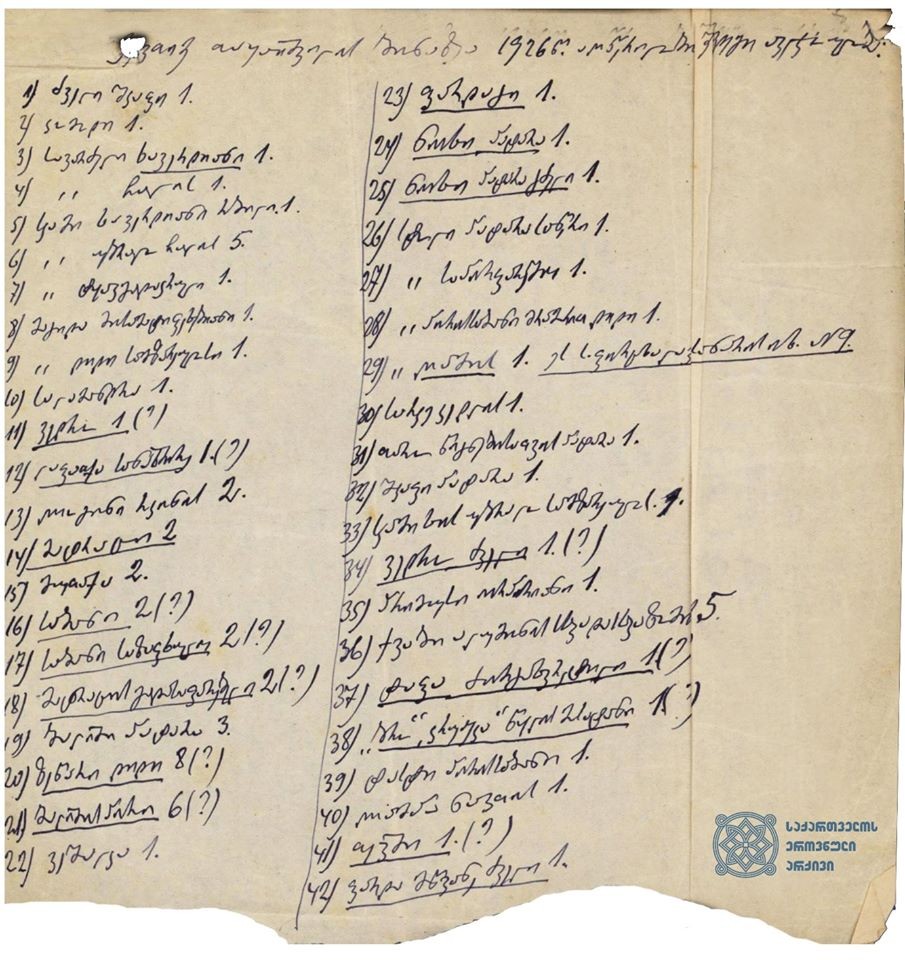
“Old wardrobe - 1 ... old bucket - 1 ... frying pan with a hole in the bottom - 1 ... plate - 1 ... old green curtain - 1.”
Inventory of Ekvtime Takaishvili’s belongings.
Leuville, 1926.
On 11 April 1945, after 25 years in exile, 82-year-old Ekvtime Takaishvili returned to his homeland.
In Georgia, he was given the opportunity to continue his scholarly work as a professor at Tbilisi State University and a member of the newly established Academy. He worked productively at both institutions and, over the course of eight years, published 16 studies, both major and minor, and prepared almost as many for publication.
On 17 September 1949, the Higher Attestation Commission of the USSR officially awarded him the degree of Doctor and the title of Professor.
In 1951, Ekvtime’s adopted daughter, Lida Poltoratskaya, was arrested, and in early 1952, Ekvtime was dismissed from the University “due to insufficient teaching workload.”
On 21 February 1953, Ekvtime Takaishvili, who was living in extreme hardship, passed away as a result of cardiac paralysis. On 24 February, only a few dozen people accompanied his remains on their final journey to Vake Cemetery.